
Guide · Updated
Raja Ampat: the complete guide
Raja Ampat is an archipelago of around 1,500 islands, cays and shoals off the western tip of New Guinea, in Indonesia's Southwest Papua province. It sits in the Coral Triangle and holds roughly 75% of the world's known coral species, which makes it one of the richest places on earth to dive, snorkel and travel by boat.
This guide covers where Raja Ampat is, what makes its reefs matter, how the main regions differ, when to go, how to get there, what the entry fees are in 2026, and how the different ways of visiting compare, from village homestays to a private yacht.
Quick facts
| Fact | Detail |
|---|---|
| Location | Off the Bird's Head Peninsula of New Guinea, Southwest Papua province, Indonesia |
| Main islands | Waigeo, Batanta, Salawati and Misool, plus hundreds of smaller islands |
| Gateway | Sorong (airport code SOQ), then boat to Waisai or straight onto a yacht |
| Best months | October to April for calmer seas; July and August are the roughest |
| Entry fees | Marine park fee plus a regency visitor levy, reported at about Rp 1.7 million in total for foreign visitors (January 2026) |
| Water temperature | Roughly 28 to 30°C year round |
| Typical trip length | 6 to 10 nights for the north; 10 nights or more to include Misool |
| Protection | Marine protected area network, shark and ray sanctuary, UNESCO Global Geopark (2023) and UNESCO Biosphere Reserve (2025) |
Where is Raja Ampat?
Raja Ampat lies off the northwestern tip of the island of New Guinea, across the water from the city of Sorong. The name means "Four Kings", after the four large islands of Waigeo, Batanta, Salawati and Misool. Around them sit hundreds of smaller limestone islands, reefs and sandbars spread across about 4.6 million hectares of land and sea, according to Greenpeace.
The regency's small capital is Waisai, on the south coast of Waigeo. Raja Ampat is now part of Southwest Papua province, whose provincial government shares responsibility for the marine conservation areas, as Kompas reported in January 2026. Only a few dozen islands are inhabited: Mongabay counts 34 inhabited islands within the biosphere reserve.
Raja Ampat and Komodo are both in eastern Indonesia but they are separate regions, a long way apart by sea, with opposite seasons. If you are weighing the two, our Komodo guide and our Komodo vs Raja Ampat diving comparison are the places to start.
Why is Raja Ampat so special?
Raja Ampat has the highest recorded diversity of reef life of any comparable area on the planet. According to The Nature Conservancy, surveys have confirmed 574 coral species here, about 75% of all known coral species, along with 1,427 reef fish species, some found nowhere else.
The same report records 17 marine mammal species, including nine whales, seven dolphins and the dugong, as well as nesting and foraging green and hawksbill turtles. It also notes at least 45 marine lakes, some holding species of sponge and stingless jellyfish found only there. Strong currents carry coral larvae from these reefs into the wider Indian and Pacific Oceans, which is part of why conservation scientists treat Raja Ampat as a global priority.
The land is remarkable too. In May 2023, UNESCO named Raja Ampat a Global Geopark covering Waigeo, Batanta, Salawati and Misool, reported by ANTARA. Its rock formations, dated between about 444 and 359 million years old, are the oldest exposed rocks in Indonesia, according to BIMP-EAGA. In September 2025, UNESCO added a Biosphere Reserve designation covering 13.5 million hectares, according to Mongabay.
How is Raja Ampat protected?
Most of Raja Ampat's waters sit inside a network of marine protected areas. In 2006 the regency became the first in Indonesia to declare an MPA network, supported by The Nature Conservancy and Conservation International, according to the same TNC report. Today the network covers more than 1.7 million hectares, according to Greenpeace.
In 2010 Raja Ampat became the first regency to declare its waters a shark sanctuary, banning the catching of sharks, rays, dugongs and turtles. The decree was later written into law, as Wetpixel reported. In January 2026 the provincial government banned anchoring across the Raja Ampat conservation area and made the use of official moorings, and payment of a mooring fee, compulsory for tour boats and liveaboards, according to Kompas.
Pressure remains. In June 2025 Indonesia revoked four of the five active nickel mining permits in Raja Ampat after an outcry over damage to forest and reef, while allowing one to continue, according to Mongabay.
What are the main regions of Raja Ampat?
Raja Ampat divides roughly into a busier north around Waigeo and the Dampier Strait, and a quieter, more remote south around Misool. Each has a different character, and most trips of a week focus on one. Our north vs south comparison goes into the trade-off in more detail.
Dampier Strait
The Dampier Strait runs between Waigeo and Batanta and is the heart of most first trips. It holds the best-known dive and snorkel sites, including Cape Kri, the reefs around Mansuar and the manta cleaning stations near Arborek. Currents are strong, which is why the fish life is so dense. Our Dampier Strait diving guide and Arborek village guide cover the area.
Wayag and Piaynemo
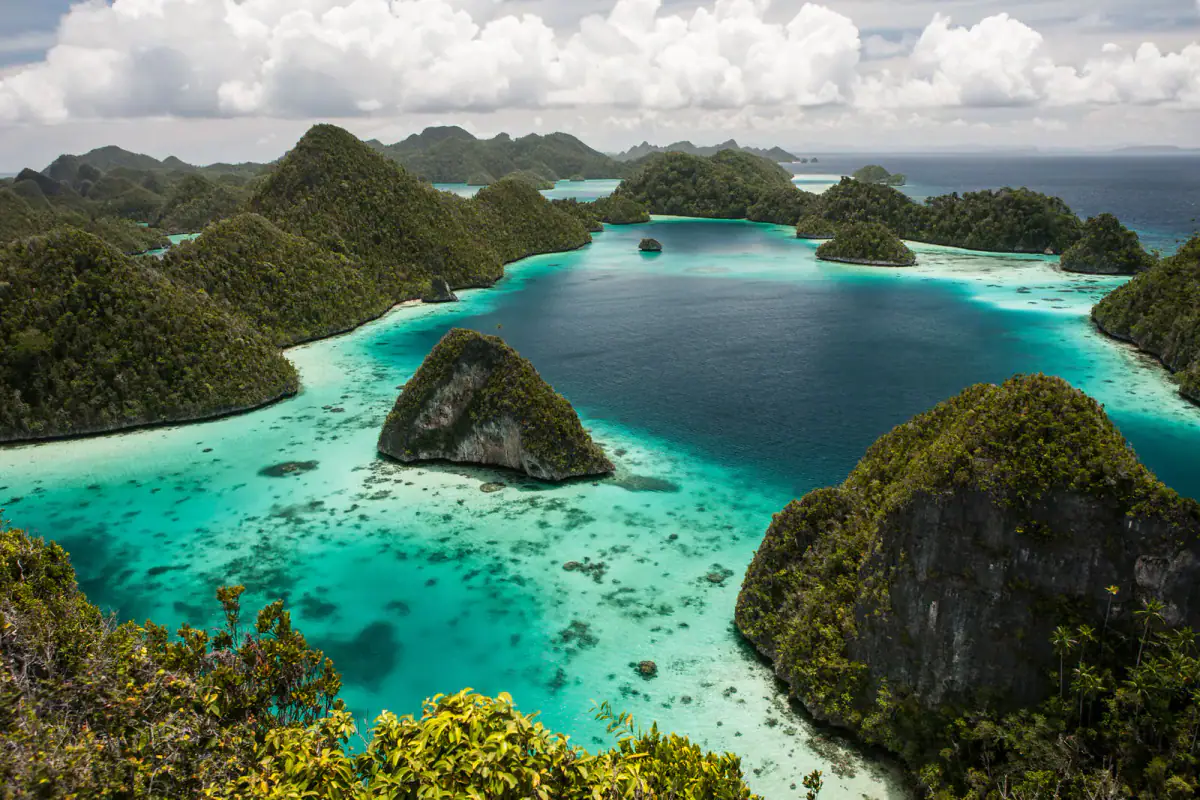
Wayag, off the northwest of Waigeo, is the classic Raja Ampat view: a climb to a ridge above dozens of steep karst islands and still turquoise lagoons. Piaynemo, in the Fam Islands further south, offers a similar view from a boardwalk and stairs that are easier to reach. Wayag is a long run from the Dampier Strait, so it suits trips of six nights or more. See our Wayag guide and Piaynemo viewpoint guide.
Misool
Misool, the southern of the four kings, is a region of jungled limestone islands, hidden lagoons, sea caves with rock art and some of the healthiest reefs in Raja Ampat. It sits inside one of the oldest no-take marine reserves in the region. It is far enough from Sorong that it usually needs its own trip or a charter of ten nights or more. Our Misool guide covers it in full.
Batanta and Salawati
Batanta and Salawati are the large, forested islands closest to Sorong. Batanta's hill forest is one of only two places where Wilson's bird-of-paradise lives, and its coast sees far fewer boats than the Dampier Strait. Salawati sits just across the strait from Sorong and is often passed on the way in or out rather than visited for long.
When is the best time to visit Raja Ampat?
The best time to visit Raja Ampat is October to April, when winds are generally lighter and the seas between the islands are calmest. July and August are the roughest months, when the southeast monsoon brings stronger winds and choppier water, according to Wilderness Travel.
Rain falls in every month, usually in short showers rather than all-day downpours, according to Aqua Expeditions, so the season is defined more by wind and sea state than by rainfall. Many dive guides rate January to March highest for manta encounters at Dampier Strait cleaning stations such as Manta Sandy, according to Meandering Wild. On the boats on our board, the Raja Ampat season runs from October or November to April, after which most yachts sail west for the Komodo season.
| Month | Sea and weather | What it means for a trip |
|---|---|---|
| January | Generally good; occasional stronger winds in open water | Peak season; strong manta month |
| February | Generally good; occasional stronger winds in open water | Peak season; book early |
| March | Often calm, with rain increasing | Good conditions and fewer boats |
| April | Often calm; transition month | Last full month for most yachts |
| May | Transition; more rain | Few private yachts remain |
| June | Wetter; winds building | Most yachts are in Komodo |
| July | Southeast winds, rough water | Roughest month; generally avoided |
| August | Southeast winds, rough water | Generally avoided |
| September | Winds easing | Quiet; very limited yacht choice |
| October | Calm; season opens | Yachts arrive; quieter anchorages |
| November | Calm | Full fleet in place |
| December | Generally good | Holiday dates fill early |
For a closer look at each month, see our Raja Ampat weather by month and best time to visit Raja Ampat guides.
How do you get to Raja Ampat?
You get to Raja Ampat by flying to Sorong, in West Papua, and then taking a boat. There is no international airport in Raja Ampat itself, so almost every trip begins at Sorong's Domine Eduard Osok airport (SOQ).
- Fly to a hub in Indonesia: International travellers usually arrive through Jakarta, Bali, Makassar or Manado.
- Fly to Sorong: Garuda Indonesia and Batik Air fly from Jakarta, and there are services from Makassar and Manado, based on FlightStats schedule data. From Bali you will normally connect through one of these hubs.
- Cross to Waisai or board your boat: Homestay and resort guests take the public fast ferry from Sorong to Waisai, a crossing of about two hours in calm seas, according to Ocean Earth Travels. The timetable changed in January 2026, so check current departures locally. Yacht and liveaboard guests usually board directly in Sorong harbour.
- Arrive a day early: Domestic connections in eastern Indonesia can run late, so a night in Sorong before boarding protects the start of your trip.
Our guides to getting from Sorong to Raja Ampat and getting to Raja Ampat from Bali cover routes and timings in more detail.
How much is the Raja Ampat entry fee in 2026?
Foreign visitors to Raja Ampat pay two separate charges: the marine park conservation fee and a regency visitor levy. As of January 2026, the two together come to about Rp 1.7 million per foreign visitor, after the regency raised its own levy from Rp 300,000 to Rp 1 million, according to TTG Asia. Children under 12 are exempt from the regency levy.
The marine park fee is sold online through the Raja Ampat marine park authority or in person at its office in Waisai, and covers divers, snorkellers and non-divers alike. The regency levy is reported to be charged per visit, so leaving and re-entering may mean paying again.
Sources do not fully agree on the split. A visitor guide updated in August 2026 lists the marine park permit and the visitor entry ticket at about Rp 1 million each, which would put the total above the TTG Asia figure. Fees here have changed several times and no consolidated official tariff for 2026 is published in English, so treat these numbers as a guide and confirm before you travel. Our marine park permit guide explains how the fee appears on a charter quote.
| Charge | Who sets it | What to know, as of 2026 |
|---|---|---|
| Marine park conservation fee | Raja Ampat marine park authority | Per person; buy online or in Waisai |
| Regency visitor levy | Raja Ampat regency | Rp 1 million for foreign visitors; children under 12 exempt |
| Reported combined total | About Rp 1.7 million per foreign visitor (TTG Asia, January 2026) | |
| Mooring fee | Province, for tour boats and liveaboards | Charged to the boat operator |
What are the ways to visit Raja Ampat?
There are four main ways to visit Raja Ampat: a village homestay, a dive or eco resort, a cabin on a shared liveaboard, or a private yacht charter. They differ mainly in how far you can travel, how much privacy you get, and how flexible the days are.
Homestays are simple guesthouses run by local families on islands across the north. Resorts offer more comfort and a house reef, with day trips by boat. Liveaboards sell cabins on a fixed route shared with other guests. A private yacht gives your group the whole boat, crew and route.
| Option | Where you sleep | How far you reach | Pace and privacy | Best for |
|---|---|---|---|---|
| Homestay | Family-run bungalow on one island | Day trips from base, mostly in the north | Simple, social, local | Budget travellers and independent divers |
| Resort | Resort room or villa | Day trips from base | Comfortable, fixed base | Couples and divers who want one location |
| Shared liveaboard | Cabin on a shared boat | Wide range on a set route | Fixed schedule, strangers on board | Keen divers on a set itinerary |
| Private yacht | Your own cabins on a crewed boat | Wide range, including Wayag and Misool | Your route, your pace, your group only | Families, friends and couples wanting flexibility |
For a fuller comparison, read our liveaboard vs private charter guide.
Seeing Raja Ampat by private yacht
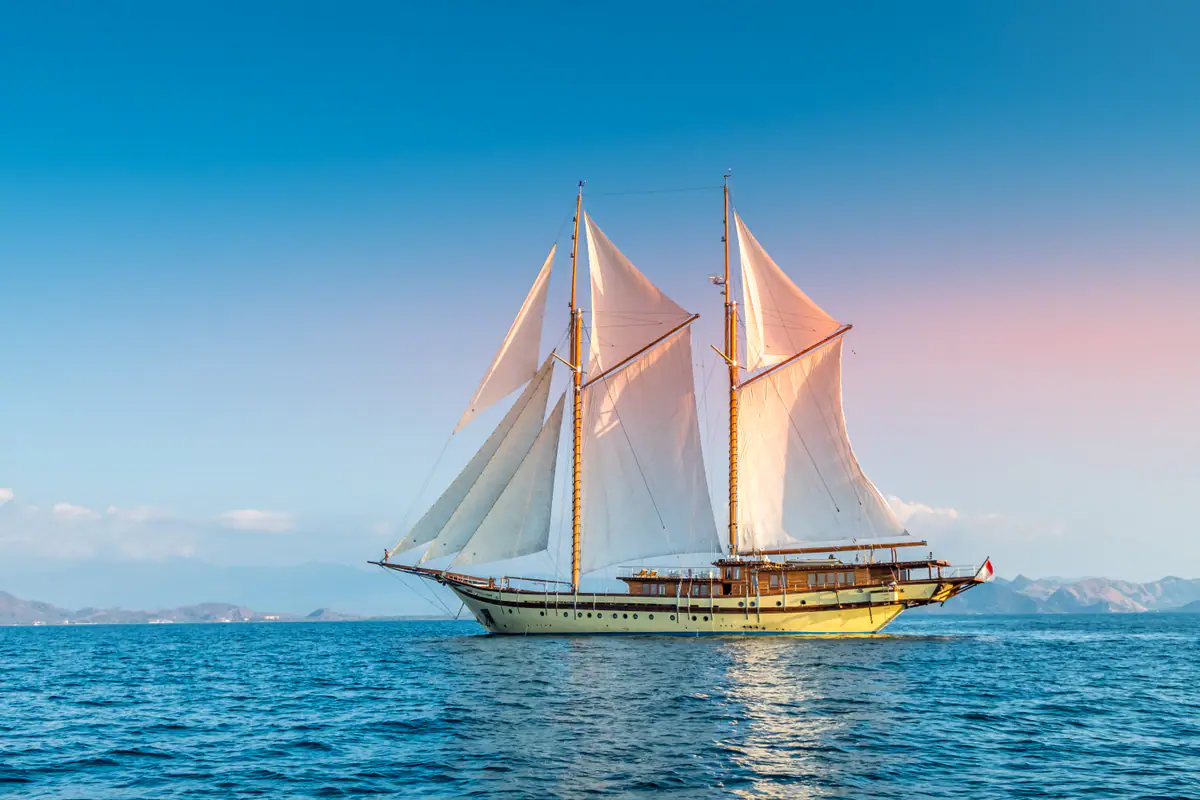
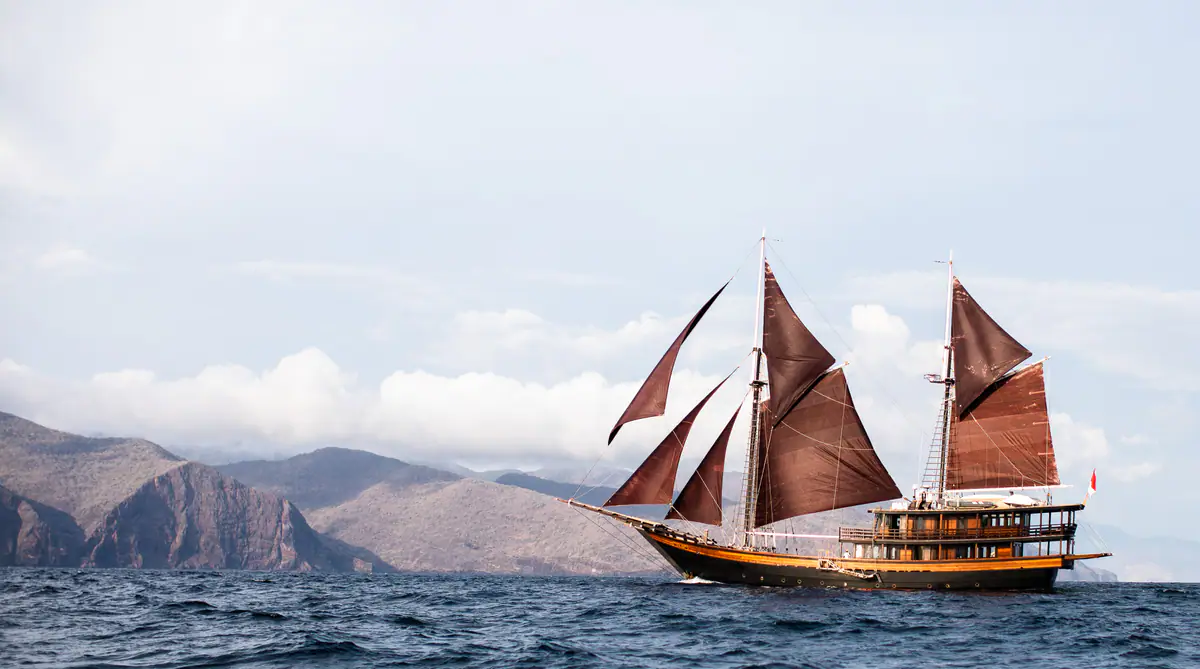
A private yacht suits Raja Ampat because the distances are large and the best places are spread out. With your own boat, the crew can time Wayag for the morning light, wait out a passing squall in a sheltered bay, or push on to Misool without changing rooms or schedules.
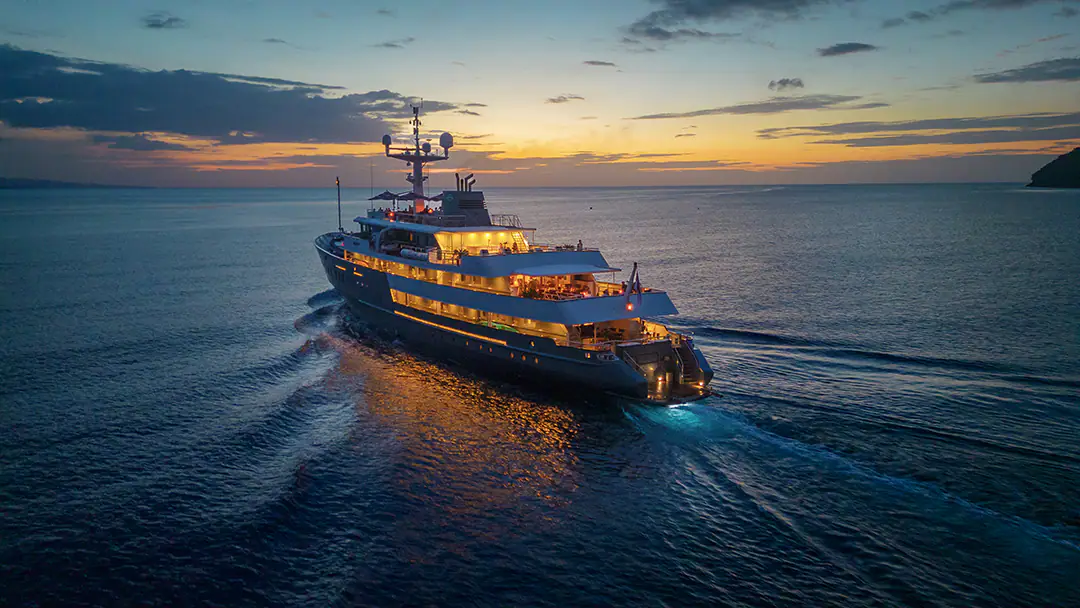
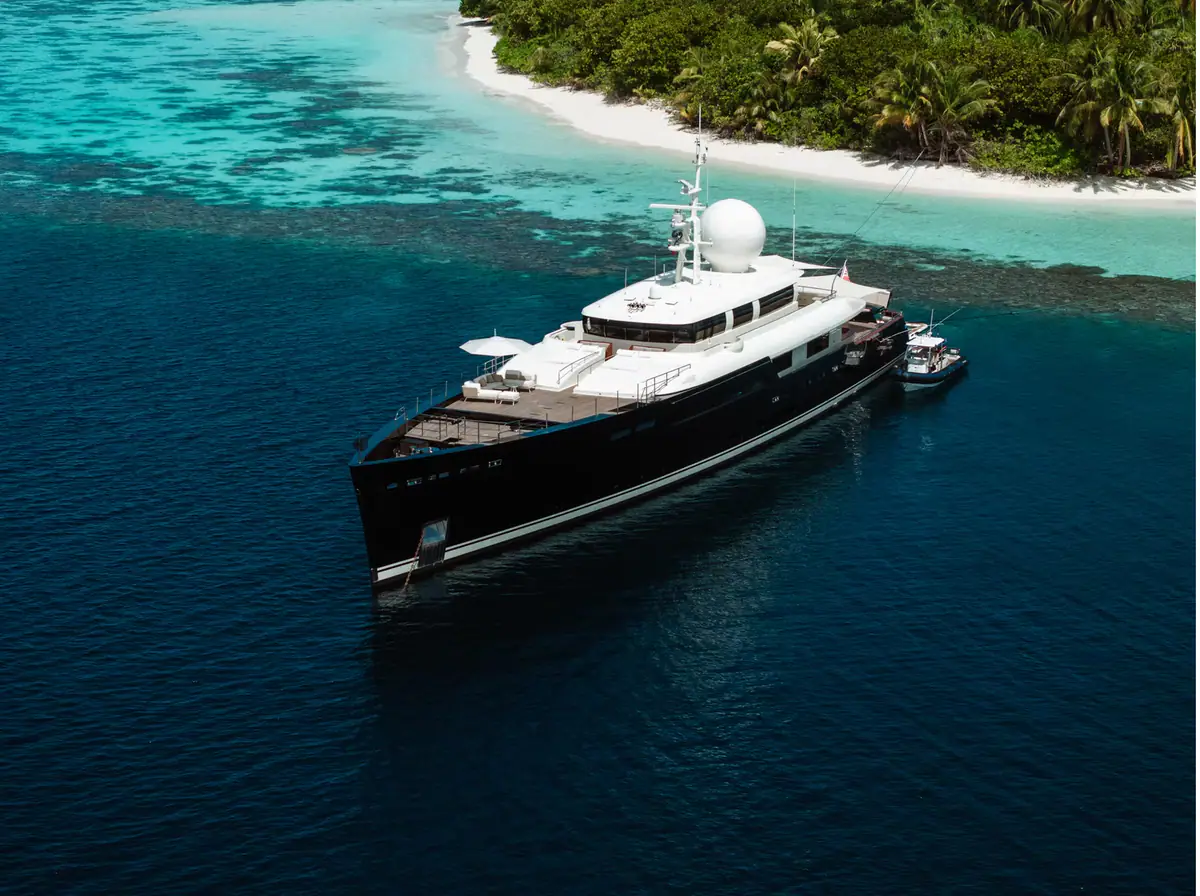
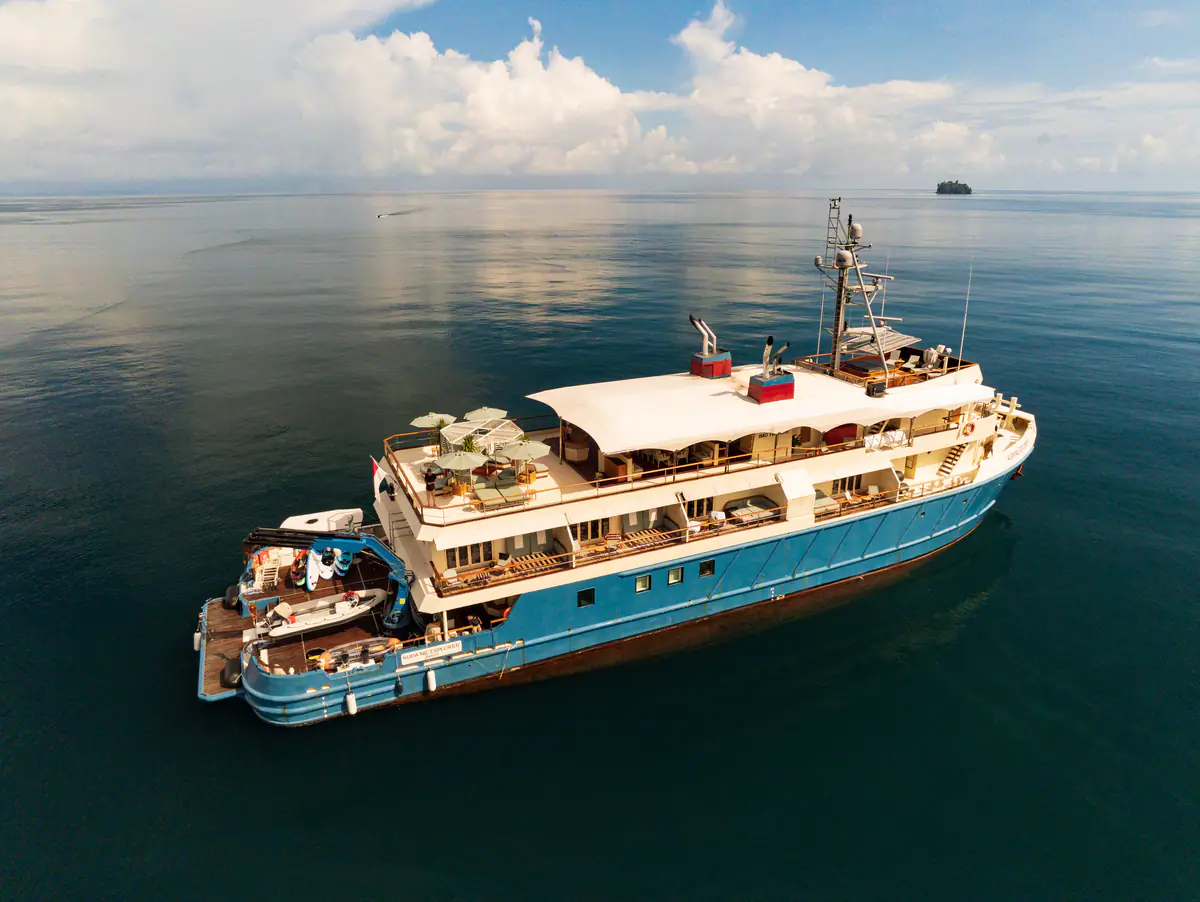
The boats on our board that sail Raja Ampat number 54, ranging from a 20 metre phinisi for a handful of guests to a 65 metre flagship, and from two guests to thirty. The large majority are traditional wooden phinisi, with a smaller number of steel expedition yachts built for longer range. Rates are quoted for the whole boat, per night, and usually include the crew, meals, soft drinks, fuel for the standard route, tenders and snorkelling gear.
A typical first week runs from Sorong through the Dampier Strait, Arborek and Piaynemo to Wayag and back. Our 7-day itinerary sets out one version, and our 14-day itinerary shows how a longer trip adds Misool. You can browse the fleet, see which yachts are open for your dates, or send your dates and our concierge will match them to suitable boats. Our Raja Ampat yacht charter guide explains how chartering works.
Diving and snorkelling in Raja Ampat
Raja Ampat is one of the world's great dive destinations, and much of it is just as rewarding for snorkellers. Many reefs rise to within a few metres of the surface, so non-divers see the same corals, turtles and schools of fish that divers do.
The Dampier Strait has the strongest currents and densest fish life, with sites like Cape Kri and the manta cleaning stations near Arborek. The north has the karst walls and channels around Wayag. Misool is known for soft coral, reef walls and fish life inside its no-take reserve. Currents can be strong, so dives are planned around the tide by local guides. Mooring rules now apply across the conservation area, so boats tie up to fixed buoys instead of dropping anchor near reefs.
Start with our Raja Ampat diving guide, our snorkelling guide and our manta ray guide. Guests who want to learn on board can read about diving courses on a charter, and those who would rather stay above the water can read Raja Ampat for non-divers.
Where can you see birds of paradise in Raja Ampat?
You can see two birds of paradise in Raja Ampat that live almost nowhere else: the red bird-of-paradise and Wilson's bird-of-paradise. Both are best seen on a guided walk into the forest at dawn, when the males display.
The red bird-of-paradise lives only on Waigeo, Batanta and a few nearby small islands, according to BirdLife International, which lists it as Near Threatened. Wilson's bird-of-paradise is endemic to Waigeo and Batanta, mostly in hill forest between about 300 and 1,000 metres, according to the Australian Museum. Walks are led by local guides. See our birds of paradise guide for how a walk works.
How much does a Raja Ampat trip cost?
The cost of a Raja Ampat trip depends mostly on how you stay. Flights to Sorong and the entry fees are similar for everyone; accommodation and boats make up the difference.
| Cost line | What to expect |
|---|---|
| Flights | Domestic flight to Sorong from a hub such as Jakarta, Makassar or Manado, on top of international flights |
| Entry fees | About Rp 1.7 million per foreign visitor in total, as of January 2026 |
| Ferry to Waisai | Public fast ferry from Sorong for homestay and resort guests |
| Private yacht (whole boat, per night) | From about US$1,750 to US$55,430 on our board; median about US$10,000 |
| Typical private yacht range | Half the boats on our board sit between about US$5,600 and US$14,300 a night |
| Usual extras | Alcohol, gratuities, diving on boats without their own dive programme, flights |
Of the 54 Raja Ampat boats on our board, 12 start below US$5,000 a night, 14 between US$5,000 and US$10,000, 21 between US$10,000 and US$20,000, and 7 above US$20,000. Because the rate covers the whole boat, a larger group sharing a mid-size phinisi can bring the per-person cost much closer to a shared liveaboard. Our Raja Ampat trip cost guide and private boat charter cost guide break this down further.
How to travel responsibly in Raja Ampat
Responsible travel in Raja Ampat comes down to protecting the reef, respecting village customs and supporting local people. The region's protection is partly funded by visitor fees, so paying them properly is the first step.
- Do not touch or stand on coral, and keep fins clear of the reef when snorkelling in shallow water.
- Use boats that moor rather than anchor; anchoring is now banned across the conservation area.
- Ask before photographing people in villages, and follow your guide's lead on dress and behaviour.
- Take rubbish back with you; waste handling on small islands is limited.
- Buy local, from homestay meals to handicrafts and village guiding fees.
- Never buy shark, ray or turtle products; they are protected throughout Raja Ampat.
Our note on responsible yacht charter covers how this applies on board, and is Raja Ampat safe? covers practical safety.
Frequently asked questions
Where is Raja Ampat located?
Raja Ampat is in eastern Indonesia, off the northwestern tip of New Guinea, in Southwest Papua province. Its four main islands are Waigeo, Batanta, Salawati and Misool. The nearest city and airport is Sorong, on the New Guinea mainland, from where boats cross to the islands. It is a separate region from Komodo, which lies far to the west between Sumbawa and Flores.
Is Raja Ampat worth visiting?
Yes, if reefs, wildlife and remote scenery matter to you. Raja Ampat has around 75% of the world's known coral species and more than 1,400 reef fish species, and large parts of it see few visitors. The trade-off is effort and cost: it takes at least two flights to reach Sorong and a boat from there. Our guide is Raja Ampat worth it? weighs this up.
How many days do you need in Raja Ampat?
Plan on at least six to seven nights for the north, covering the Dampier Strait, Arborek, Piaynemo and Wayag. Adding Misool in the south usually means ten nights or more, or a separate trip focused on the south. Shorter stays are possible from a single homestay or resort, but you will see a smaller area.
Do you need a permit to visit Raja Ampat?
Yes. Every visitor pays the Raja Ampat marine park fee, and foreign visitors also pay a regency visitor levy. As of January 2026 the two together are reported at about Rp 1.7 million per foreign visitor, with children under 12 exempt from the levy. Many yacht operators arrange the paperwork for you, but the fee is usually listed as a separate line on the quote.
Can you visit Raja Ampat if you do not dive?
Yes. Many reefs are shallow enough for excellent snorkelling, and the karst viewpoints at Wayag and Piaynemo, the birds of paradise, village visits, kayaking and lagoons need no diving at all. On a private yacht, the crew can plan each day around snorkelling and shore trips rather than dive times.
Is there a direct flight from Bali to Sorong?
Generally no. Most travellers from Bali connect through Jakarta, Makassar or Manado, and schedules change, so check current options when you book. Because connections can run late, it is sensible to arrive in Sorong the day before your boat departs or your ferry leaves for Waisai.
What is the difference between Raja Ampat and Komodo?
They are separate regions with opposite seasons. Komodo, near Flores, is best from roughly May to October and is known for its dragons and short charters from Labuan Bajo. Raja Ampat, off New Guinea, is best from October to April and is known for coral diversity and longer trips from Sorong. Most private yachts move between the two each year.
How much does a private yacht in Raja Ampat cost?
On our board, Raja Ampat boats start from about US$1,750 a night for the whole boat, with a median of about US$10,000 and the largest expedition yacht at about US$55,430. The price depends on size, cabins, crew and finish. Marine park fees, alcohol and gratuities are usually extra.
Sources
- The Raja Ampat Islands: In the Heart of the Coral Triangle (The Nature Conservancy, via Reef Resilience Network)
- 5 things you need to know about the last paradise on earth (Greenpeace International)
- Just as Raja Ampat fetches UNESCO biosphere reserve title, nickel mining looms (Mongabay, October 2025)
- Indonesia halts most nickel mining in Raja Ampat but allows one controversial permit (Mongabay, June 2025)
- UNESCO tetapkan Kabupaten Raja Ampat sebagai Global Geopark (ANTARA)
- BIMP-EAGA boasts three UNESCO Global Geoparks (BIMP-EAGA)
- Raja Ampat shark sanctuary becomes law (Wetpixel)
- Tekan kerusakan terumbu karang, Raja Ampat perluas mooring dan wajibkan retribusi (Kompas, January 2026)
- Raja Ampat raises tourism fees to support conservation and communities (TTG Asia, January 2026)
- Marine Park Fee (Raja Ampat MPA Management Authority)
- When is the best time to visit Raja Ampat? (Wilderness Travel)
- Best time to dive Raja Ampat (Meandering Wild)
- Sorong (SOQ) arrivals (FlightStats)
- Sorong to Waisai ferry schedule 2026 (Ocean Earth Travels)
- Red bird-of-paradise species factsheet (BirdLife International)
- Wilson's Bird of Paradise (Australian Museum)
- Raja Ampat: best time to visit (Aqua Expeditions)
- Update on official fees in Raja Ampat (Raja Ampat Biodiversity)